
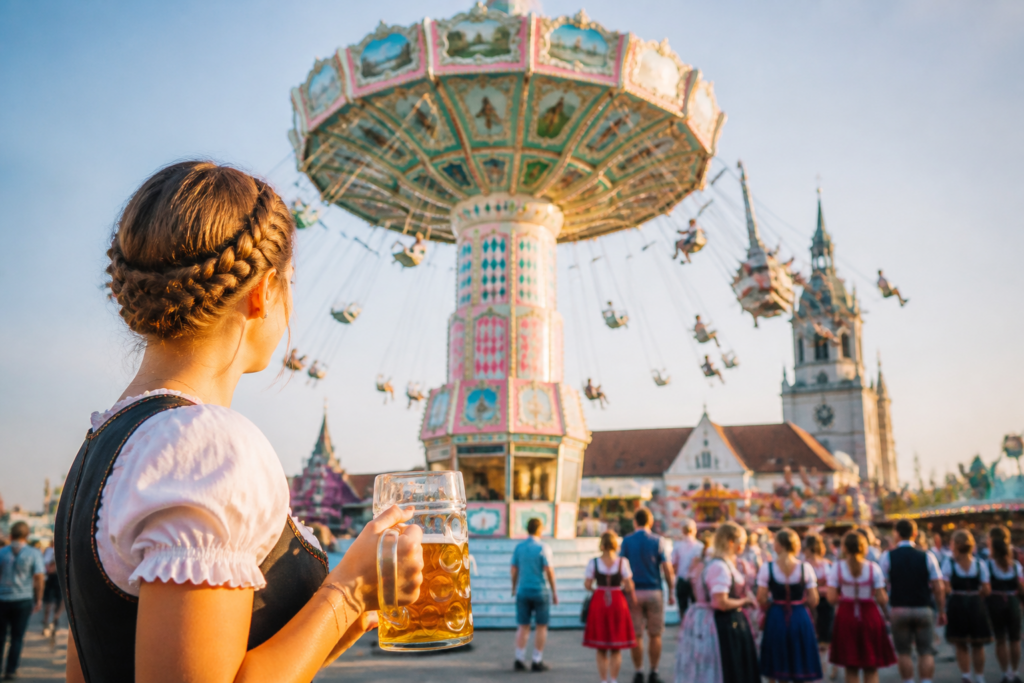
Most travellers who decide to do a German beer festival automatically start Googling Oktoberfest. What very few of them realise is that Munich runs a second, significantly less chaotic festival on the exact same fairgrounds just five months earlier. That festival is Frühlingsfest, and this Munich spring festival travel guide is written for the kind of traveller who wants the full tent experience — the brass bands, the litre steins, the benches packed with strangers who become friends — without the elbow-to-elbow crowds, eye-watering accommodation prices, and logistical headaches that come with Oktoberfest’s global fame.
If you are planning a Europe trip around a Bavarian festival and you have not yet committed to a date, read this first. It might save you money, earn you more breathing room, and give you a better story to tell.
Springfest vs Oktoberfest: timing, crowds, costs and who it actually suits
The most important practical difference is timing. Oktoberfest runs in late September into early October, solidly peak autumn-travel season in Europe, while Frühlingsfest takes place over roughly two weeks in late April into early May. That single fact cascades into a long list of advantages for the adventure traveller: flights to Europe in late spring are considerably cheaper than in late September, accommodation in Munich is easier to find and usually costs less, and the city itself is quieter on the streets between festival sessions.
Both festivals use the Theresienwiese fairgrounds in central Munich, so the geography is identical. The scale is not. Frühlingsfest is a noticeably smaller event, with fewer tents, shorter queues for rides, and a crowd that skews more local and relaxed. You will find plenty of tourists, but the ratio of organised tour groups and bucket-list-tickers is lower, and the atmosphere in the tents tips toward convivial rather than frenetic, which makes it far easier to actually have a conversation with the people next to you.
On cost, expect a litre of beer to run around 8 euros inside the tents, with food varying by dish. Budget at least 50 euros per day in cash for drinks, food, and rides, because cards are not always accepted at stalls and fairground attractions. That per-day figure is similar to Oktoberfest, but the surrounding costs — flights, hotels, table reservations — are where the spring timing delivers real savings.
Who should still choose Oktoberfest? If the sheer spectacle of millions of people sharing one city’s energy over 16 days is itself the point, Oktoberfest delivers something Springfest genuinely cannot match. For travellers who want big-tent Bavarian culture with room to move, spontaneous seat-finding, and the freedom to fit the festival inside a broader Europe itinerary without planning a year in advance, Springfest Munich is rapidly becoming the festival of choice for savvy travellers.
Springfest essentials: tents, rides, daily rhythm and what to bring
Frühlingsfest is held on the Theresienwiese fairgrounds in Munich’s Ludwigsvorstadt district, the same open expanse that hosts Oktoberfest. Entry to the grounds and into the beer tents is free, so you pay only for what you eat, drink, and ride, which makes it easy to calibrate your spending as you go.
The festival centres on two main beer tents. One is the more traditional option: long wooden tables, brass-band music played at a volume that still lets you talk across the table, and classic Bavarian food like Weißwurst, Brezn, and Obatzda. The other runs louder, with live acts and a more party-forward atmosphere that fills up fast on weekend evenings. Alongside the tents, a covered outdoor beer garden suits a sunny afternoon perfectly; it is quieter than the main halls, easier to find a seat mid-afternoon, and a good base if someone in your group wants a breather from the noise.
The daily rhythm matters, so it is worth understanding before you arrive. Mornings and early afternoons are calm; families wander the fairground, the funfair runs at a gentle pace, and you can get a seat in the beer garden without any strategy. From around 5pm things shift, and by 7 or 8pm on a Friday or Saturday the main tents are loud and busy. Knowing this means you can front-load a ride session and a leisurely beer-garden lunch, then choose whether to stay for the full evening push or head out before the peak.
The fairground itself is a genuine adventure draw. A 50-metre Ferris wheel provides some of the best elevated views of Munich you will find without paying for a tower tour, and thrill-seekers will find roller coasters, a top-spin ride, wild-water rafting, and bumper cars alongside smaller games and stalls. Every ride is individually priced, so you choose your own level of commitment. Beyond the rides, special events punctuate the two weeks: fireworks go up every Friday evening at 10pm, and the first Saturday hosts Bavaria’s largest flea market, with around 2,000 vendors covering everything from antiques to curiosities.
For what to wear and bring, the key considerations are comfort and practicality. Layers are essential, because late April in Munich can be genuinely warm in the afternoon sun and sharp by 9pm, especially in the outdoor beer garden. Closed shoes with a firm sole are worth wearing if you plan to stand on the benches inside the tents, which is where most of the dancing happens. Bring a small day bag or secure backpack for a light waterproof layer, a portable charger, and your cash. Traditional Bavarian dress, a dirndl for women and Lederhosen for men, is absolutely welcome and many visitors wear it, but it is not required.
Munich spring festival travel guide: logistics, bookings and on-the-ground tactics
Three to four nights in Munich is the right amount for a Springfest-focused trip. That gives you two proper festival days, time to explore the city at a reasonable pace, and a recovery morning when you need it.
For accommodation, the planning window is more forgiving than at Oktoberfest. You do not need to book a year in advance, though hotels and hostels within walking distance of Theresienwiese do fill up for weekends during the festival period, so booking two to three months out is sensible for a Friday or Saturday night. Mid-week stays are often available with shorter notice and at better prices, which is one more reason to structure your itinerary to include at least one weekday visit.
Table reservations work differently here than at Oktoberfest. For larger groups of eight or more, and for Friday and Saturday evenings in the main tents, having a reservation removes uncertainty. For groups of two to four arriving before 5pm on a weekday, you can almost always find a spare seat by asking politely and working your way down the bench rows. The etiquette is simple: ask before sitting, share tables without hesitation, and tip your server. Benches are for standing on; tables are not.
Getting there is straightforward. U-Bahn lines U4 and U5 stop directly at Theresienwiese, with the journey from Munich’s main station taking around five minutes. If you are arriving from Munich Airport, taxis run around 85 to 110 euros depending on traffic. Late at night after a session in the tents, the U-Bahn is your safest and most reliable route back, so avoid driving and lean on public transport or a ride-hail app for the final stretch if the subway has stopped.
On money: cash is still necessary for fairground rides and many food stalls, so plan to carry 50 to 80 euros per festival day. A litre of beer costs around 8 euros, food varies, and rides are individually priced. Keep a backup card accessible but do not rely on it inside the festival grounds, and secure your valuables in a zip pocket or small crossbody bag before getting on any ride.
Munich spring festival travel guide: logistics, bookings and on-the-ground tactics
Designing a Springfest-based mini-adventure: 3-4 days in and around Munich
A workable structure for a four-day trip looks roughly like this. Arrive on your first afternoon, check in, and head to the festival for an early evening session in the beer garden rather than the full tent experience; it is a good way to get your bearings without committing to a big night. Day two is your full festival day: ride the Ferris wheel and a couple of the thrill rides in the afternoon, grab a seat in your preferred tent by early evening, and stay for the bands. Day three is an active day out of Munich, returning in the evening for a lighter second festival visit or a meal at a traditional beer hall. Day four is a loose morning in the city before travel.
For day trips, the options that suit adventure travellers best are the Bavarian Alps and the lakes to the south of Munich. The Zugspitze region, reachable by train, offers good hiking at lower elevations in late April and spectacular scenery even when the higher paths still carry snow. The lakes around the Bavarian foothills, Starnberger See and Ammersee are both under an hour by S-Bahn, give you easy cycling, swimming if the water temperature cooperates, and a dramatically different pace from the festival. Neuschwanstein Castle is worth considering if you have not been; the train journey to Füssen takes just under two hours and the surrounding walking is genuinely scenic.
The key to balancing a big festival night with an active next day is sequencing. Put your most demanding outdoor plans after your lighter festival evenings, not your heaviest ones. A Tuesday evening beer garden session followed by a Wednesday hike works well; a Saturday all-nighter followed by a Sunday alpine start does not. Build in at least one completely flexible half-day for weather too, because late April in Bavaria can deliver sunshine and cold rain within the same afternoon.
Making Springfest your Europe shoulder-season anchor
Late April and early May sit squarely in the European shoulder season, which creates advantages that compound on each other. Train travel across central Europe is less crowded and often cheaper in spring than in the summer peak. Alpine huts at lower elevations are open but not full. City accommodation across the continent has not yet hit its summer price ceiling. If you are planning a rail loop, a climbing trip in the Alps, or a multi-city itinerary through central Europe, dropping Springfest into the middle as your one big festival anchor is logistically clean in a way that late-September Oktoberfest rarely is.
Useful pairings from Munich include a rail leg east to Salzburg, Vienna, or Prague before or after the festival; a trip south into Austria or northern Italy for trekking or via ferrata once the lower-elevation routes are clear; or a westward arc through Switzerland. From Munich’s main station you are well-connected to most of central Europe without needing to fly. Book long-distance train legs two to four weeks in advance for the best fares, and try to arrive and depart on weekdays rather than weekends to avoid both price spikes and crowded carriages.
For those who want to go deeper into Springfest planning, including day-by-day timing, special events like Firework Fridays and the Giant Flea Market, or the option of joining a hosted festival-focused trip with accommodation and logistics taken care of, Thirsty Swagman has a dedicated Springfest resource and guided trips on their site worth bookmarking as your next stop.