

Most of us think of mindfulness as a luxury—something that requires a quiet room, a silk cushion, and twenty minutes of free time that we simply don’t have. We imagine a monk on a mountain, far away from the chaos of emails, crying children, and traffic jams. But this is a misconception. Mindfulness isn’t about escaping your life; it’s about being fully present within it.
The most powerful tool in your mental health toolkit is the “Micro-Pause.” Science shows that stopping for even thirty seconds can trigger an Amygdala Reset. When you are stressed, your amygdala (the brain’s alarm system) takes over. By pausing, you interrupt that “fight or flight” response and re-engage the prefrontal cortex—the logical part of the brain that helps you stay calm.
If you’re looking for ways to integrate these pauses into a busy schedule, many users in the Liven app feedback sections mention how helpful it is to have digital reminders that prompt these short bursts of awareness throughout the day. You don’t need a meditation retreat; you just need to learn how to pause.
1. The “3-3-3” Sensory Grounding
When your mind starts to spiral into “what-if” scenarios about the future or regrets about the past, you need a way to snap back to the present. The 3-3-3 technique is a rapid sensory anchor.
How to do it: Stop what you are doing and quietly name:
- 3 things you see (a blue pen, a crack in the wall, a cloud).
- 3 sounds you hear (the hum of the fridge, a distant car, your own breath).
- 3 parts of your body you can move (wiggle your toes, roll your ankles, shrug your shoulders).
Why it works: Anxiety lives in the mind, but calm lives in the body. By forcing your brain to process external sensory data, you shift from “worry mode” to “observation mode.” It’s a fast way to remind your nervous system that you are safe in this physical moment.
2. Box Breathing (The Navy SEAL Method)
If it’s good enough for elite soldiers in high-pressure situations, it’s good enough for a stressful Tuesday at the office. Box breathing is a rhythmic pattern that physically forces your body to relax.
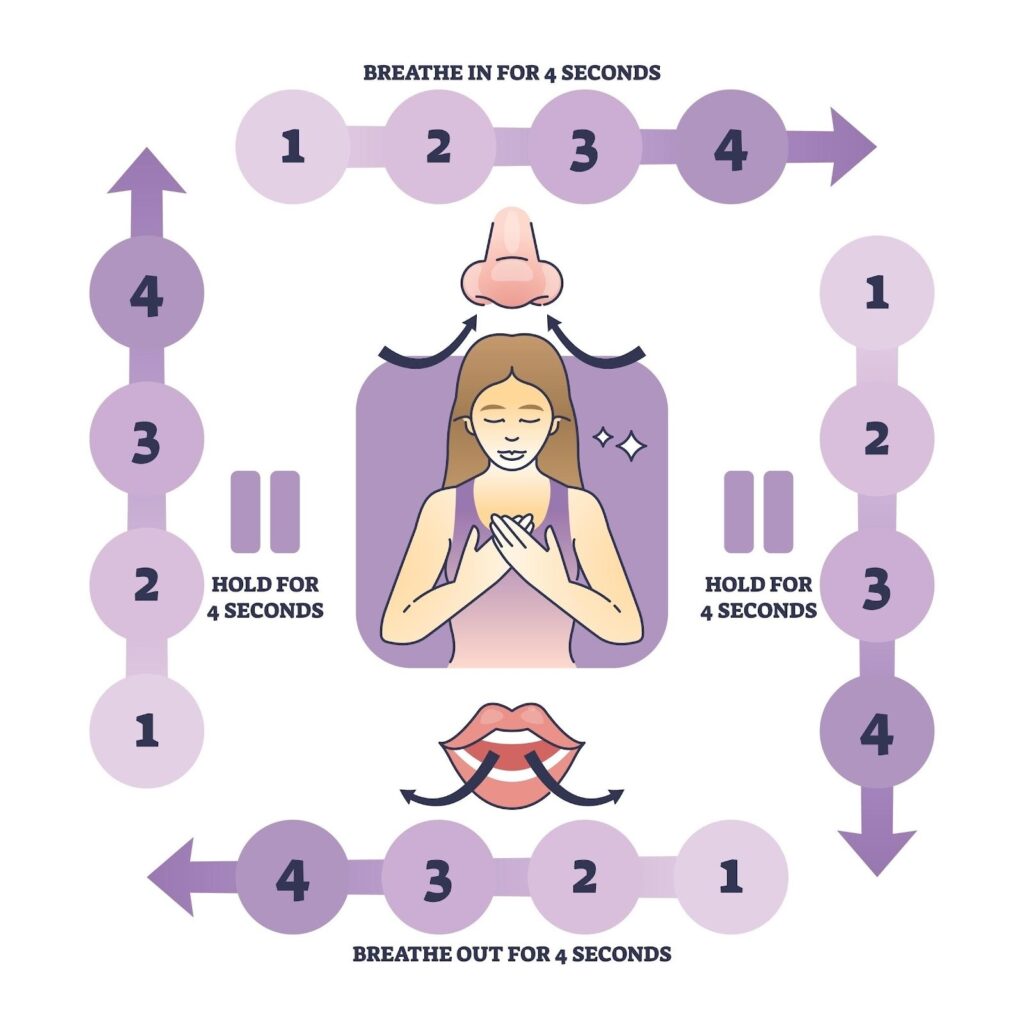
How to do it: 1. Inhale through your nose for a count of 4. 2. Hold that breath for a count of 4. 3. Exhale slowly through your mouth for a count of 4. 4. Hold your lungs empty for a count of 4. Repeat this cycle four times.
Why it works: This technique regulates the autonomic nervous system. By controlling the rhythm of your breath, you signal to your heart to slow down and your blood pressure to drop. It is a biological “hack” for composure.
3. Mindful “Transit” Moments
We spend a huge portion of our lives in “dead time”—waiting for a kettle to boil, standing in line at the grocery store, or sitting at a red light. Usually, we fill these moments by checking our phones, which actually adds to our stress.
How to do it: Use these moments as a mental recharge. Instead of grabbing your phone, feel the weight of your feet on the floor. If you’re driving, notice the texture of the steering wheel. If you’re walking to your car, feel the air on your face.
Why it works: These are “Micro-Mindfulness” sessions. They build your “awareness muscle” without requiring any extra time in your schedule. You are training your brain to find stillness in the gaps of a busy life.
4. The “Single-Tasking” Savor
In a world that celebrates multi-tasking, doing one thing at a time has become a radical act of self-care. We often rush through mundane tasks to get to the “important” ones, but this keeps us in a state of constant hurry.
How to do it: Pick one routine activity today—like drinking your coffee, washing your hands, or eating an apple. Bring 100% of your awareness to it. Notice the temperature, the scent, the colors, and the sensations. If your mind wanders (and it will), gently bring it back to the task.
Why it works: Savoring breaks the habit of “mindless rushing.” It teaches you that peace can be found in the simplest actions, turning a boring chore into a restorative break.

5. The “Self-Compassion Break”
Often, the biggest source of stress isn’t the problem itself, but how we judge ourselves for feeling stressed. We think, “I shouldn’t be overwhelmed by this,” which only creates a second layer of anxiety.
How to do it: When things feel heavy, place a hand on your heart or your arm. Take a breath and say to yourself: “This is a moment of suffering. Stress is a part of life. May I be kind to myself in this moment.”
Why it works: This activates the release of oxytocin, the “soothing hormone.” It moves you out of self-criticism and into a state of self-support. You become your own ally instead of your own bully.
Conclusion: Calm is a Skill, Not a Gift
Mindfulness is often sold as something you either “have” or “don’t have,” but that isn’t true. It is a portable skill you can practice anywhere, from the boardroom to the laundry room.
The next time your phone pings or your stress levels rise, remember that you don’t need more time; you just need more presence. Choose one of these techniques—maybe the 3-3-3 rule or a quick round of box breathing—and give yourself the gift of a sixty-second sanctuary.